The Scheffler Paradox
The Putting Paradox of Golf’s Most Dominant Player
Between 2022 and 2024, Scottie Scheffler mounted one of the most statistically dominant stretches in modern PGA Tour history. He captured the Masters, back-to-back Players Championships, and finished atop the FedExCup standings, establishing a historic lead in the Official World Golf Ranking. Yet across that entire dominant run, Scheffler’s putting numbers appeared remarkably pedestrian.
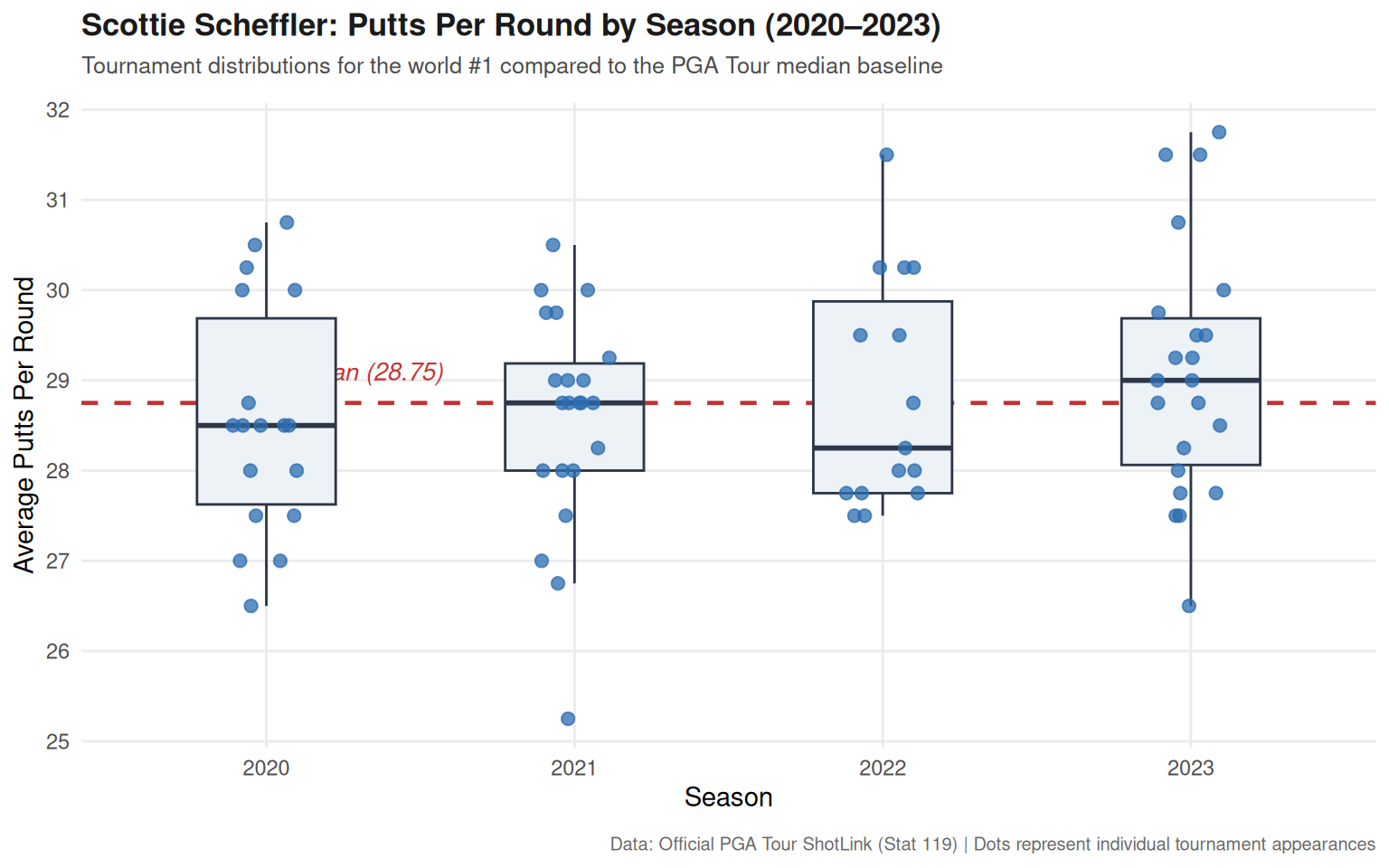
As the data reveals, Scheffler averaged 28.8 putts per round in 2022 and 29.1 in 2023—placing him right at or slightly above the tour-wide median of 28.75 putts per round. In several events, his putting average exceeded 31 putts per round, a figure that would cause most touring professionals to miss cuts.
How did the world’s best golfer dominate while putting at a tour-average rate? The answer lies in ball-striking. Scheffler led the PGA Tour in Greens in Regulation (GIR) and Strokes Gained: Tee-to-Green by wide margins. Players who hit 14 or 15 greens in regulation face 15 birdie putts from 20 to 30 feet, which naturally leads to two-putt pars and roughly 29 to 30 putts. In contrast, golfers who miss greens chip from the fringe and register one-putt up-and-downs, artificially lowering their putts per round.
The story of Scheffler’s dominance shows why raw putting counts must be contextualized: supreme ball-striking provides a high floor, and whenever Scheffler experienced even a slightly above-average week on the greens (under 28 putts per round), he was virtually unbeatable.